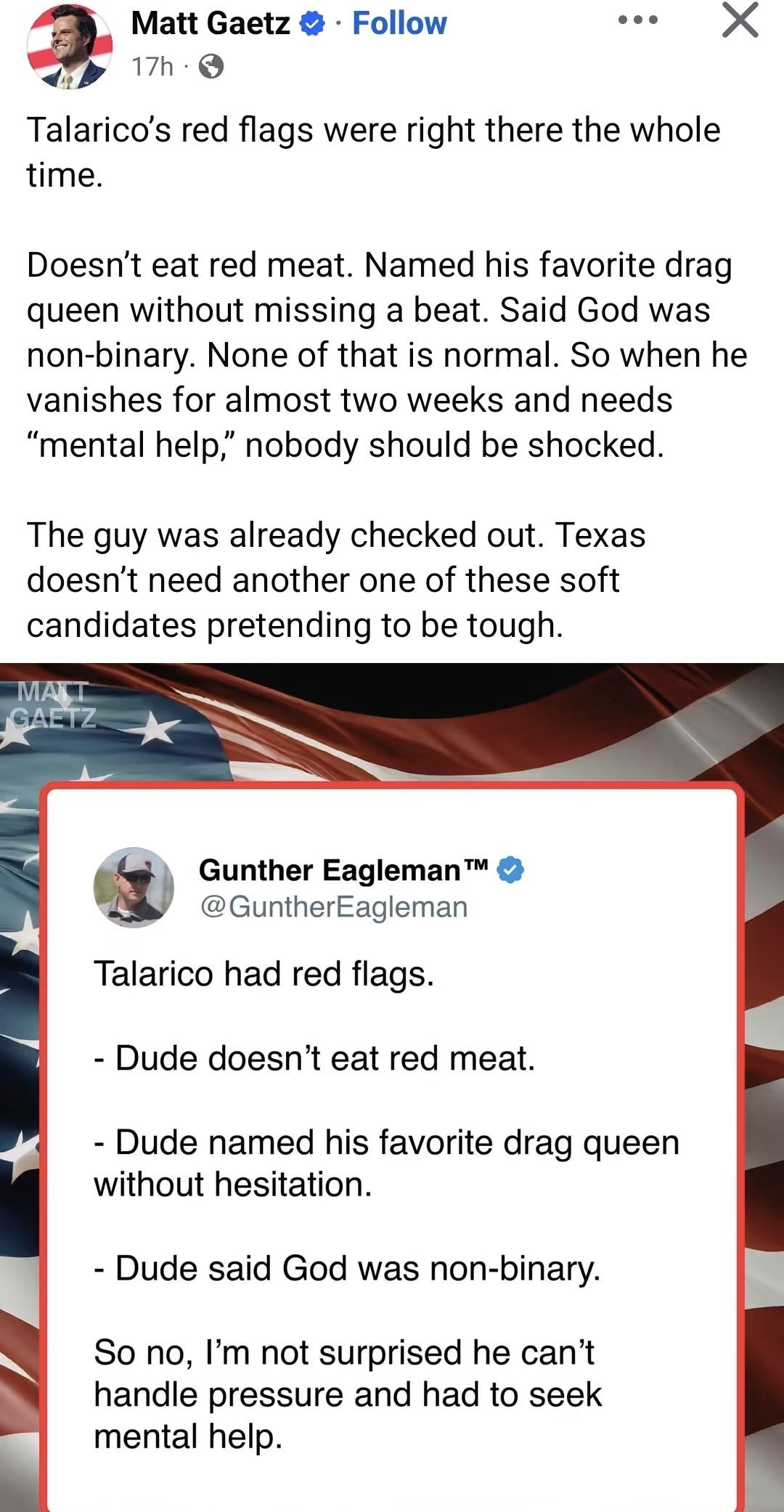
A standard political attack on social media recently took an unexpected turn when a coordinated attempt to call out a candidate backfired into a broader, surprisingly nuanced public debate. What was intended as a routine list of cultural "red flags" against a political opponent instead invited intense scrutiny, humor, and theological counter-arguments from commentators who seemed entirely unprepared to take the bait on traditional terms.
At the center of the dispute was a series of personal traits and alleged positions attributed to a political figure, ranging from dietary habits—specifically avoiding red meat—to theological interpretations regarding the nature of God and awareness of pop-culture figures like drag performers. Rather than triggering standard partisan outrage, the post ignited a wave of pushback that dismantled the criticisms item by item.
Cultural Critiques and the Changing Tone of Political Rhetoric
For years, political commentators have leveraged minor personal lifestyle details to signal strength or accuse opponents of being out of touch. However, the online response to this latest salvo suggested a growing public fatigue with shallow cultural metrics. Observers quickly pointed out that personal dietary choices or knowledge of contemporary performance art have zero bearing on a leader's ability to govern.
Many responses highlighted the absurdity of using red meat consumption as a test of masculinity or political readiness. Beyond simple personal preference, commentators noted practical, health, and regional reasons why individuals might pass on beef, pointing out how common dietary restrictions actually are across the country.
"Don’t necessarily have to be vegan or vegetarian to not eat red meat. Just need high cholesterol and a doctor that tells you what to do."
Others noted the ironies embedded in geographic demographics, highlighting that even in cattle-rich states, many residents abstain from beef due to medical conditions, budget constraints, or personal health goals. The attempt to turn basic lifestyle choices into political liability appeared to fall completely flat with a wider audience.
Deep Dives into Theology and Identity
Perhaps the most detailed counter-arguments emerged around religious rhetoric. When political commentators attempt to frame traditional theology around modern identity concepts, theologians and casual observers alike often step in to clarify traditional doctrines. The claim that discussing the non-physical, spiritual nature of God constitutes a political stance was met with detailed religious counterpoints.
"The thing is, the Bible is very clear that God transcends human gender."
Several participants pointed out that traditional Christian catechism and historical theology explicitly describe God as a spirit lacking physical human attributes or biological gender. By trying to turn deep theological discussions into soundbite-sized culture-war ammunition, critics unintentionally opened the floor to well-read commentators who thoroughly dissected the argument.
The Absence of Automated Amplification
Beyond the debate over specific claims, observers of the exchange noted a distinct shift in the overall atmosphere of the comment section itself. Typically, high-stakes political posts quickly devolve into flooded threads dominated by repetitive hostility and automated trolling. In this instance, however, the response was unusually coherent, measured, and focused on substance.
"I think it’s the lack of MAGA ruski-bot responses trying to troll that makes it all that much funnier"
While public platforms frequently struggle with automated engagement and artificial amplification, the organic nature of this specific discussion allowed genuine civic feedback to take center stage. Commentators marveled at how different public forums look when primary responses come from attentive individuals rather than pre-programmed accounts or repetitive echo chambers.
Moving Past Surface-Level Distractions
Ultimately, the interaction demonstrated the limits of attack politics centered purely on personal trivialities. When political discourse strays into attacking an opponent's diet, pop-culture knowledge, or abstract theological views, it risks alienating voters who are far more concerned with real-world issues such as the cost of living, governance, and policy outcomes.
As public political discussions continue to evolve, instances like this serve as a reminder that audience dynamics on digital platforms can change rapidly. When artificial noise drops away, voters often prove far more interested in genuine substance, nuance, and common sense than in superficial political theater.