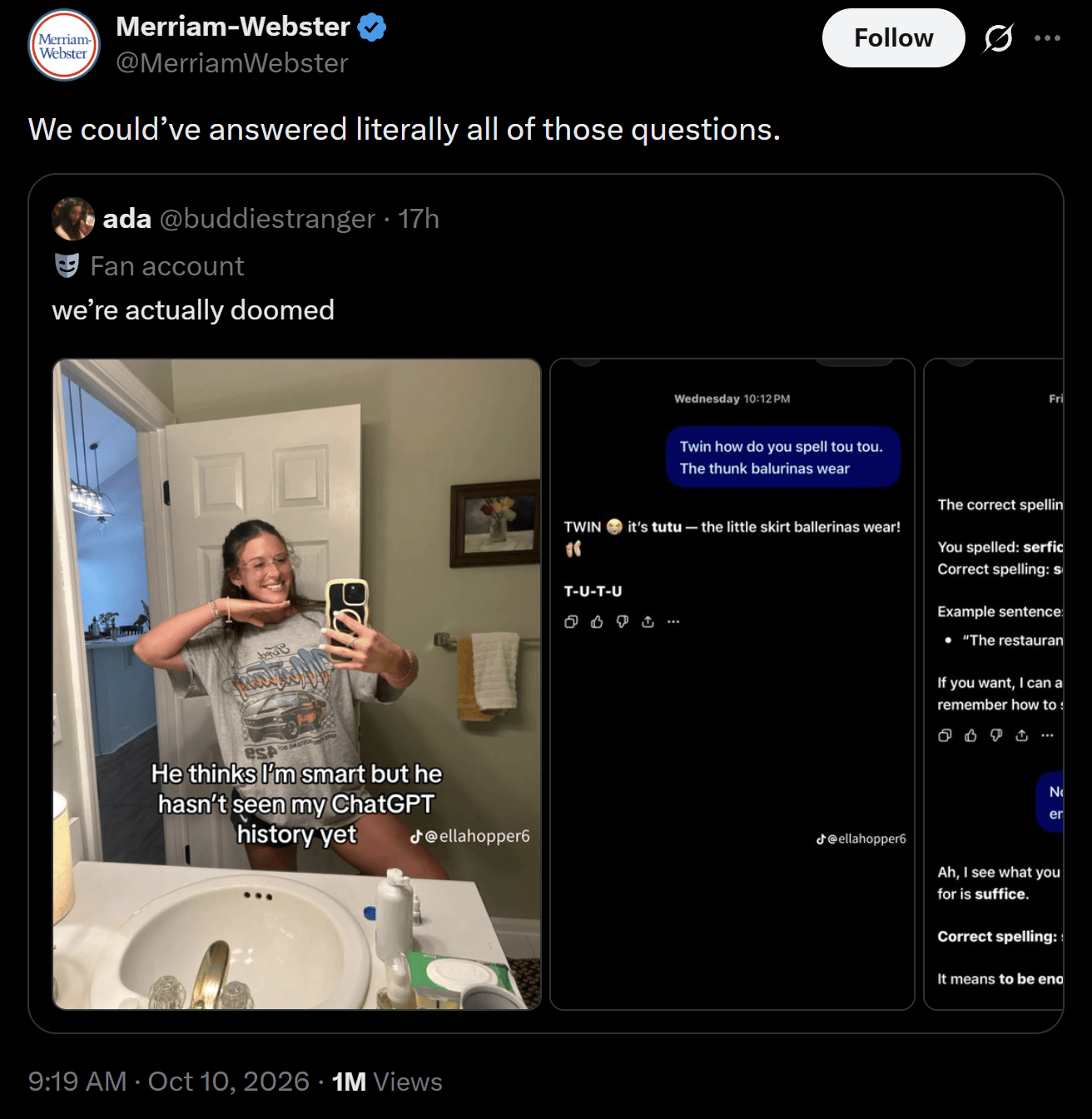
A recent tweet has ignited a fiery debate about literacy, technology, and the role of AI in education. The tweet in question features a person using ChatGPT to correct basic spelling errors, including words like 'tutu,' 'suffice,' and 'former.' Merriam-Webster responded with a pointed remark: 'We could’ve answered literally all of those questions.' This exchange has sparked a wide range of reactions, from outrage to empathy, and has raised important questions about the state of literacy and the impact of technology on learning.
The Shock and Outrage
Many were appalled by the tweet, viewing it as a sign of declining literacy and a troubling reliance on AI. One commenter exclaimed, 'we are sooo deeply fucked... illiterate and proud enough to make a post about it online.' Another added, 'Basic literacy is becoming a luxury seems like.' The misspelling of words like 'balurina' (intended as 'ballerina') and 'cerfice' (intended as 'suffice') was particularly jarring, with one person noting, 'My 10-year-old could do better than this.'
The Role of Technology
The use of ChatGPT for such basic tasks has also sparked discussions about the role of technology in education. Some argue that AI tools like ChatGPT are enabling laziness and eroding fundamental skills. 'I really try not to be all unequivocally "new technology bad," but it feels like LLMs jeopardize basic human cognitive function in a way we have not yet encountered,' one commenter observed. Others, however, see AI as a useful tool for those who struggle with spelling or have learning disabilities. 'For some people who struggle to communicate in writing, I can see that being immensely helpful and empowering,' another commenter pointed out.
Empathy and Context
Amid the criticism, some voices have called for empathy and a broader perspective. One educator noted, 'If this is a newer post of hers, I’d guess that she was somewhere between 4th and 6th grade when the pandemic hit. And while many kids worked to overcome the educational deficit of that era, as an educator myself, I cannot underscore the impact that it made on what we might call basic knowledge.' Another commenter added, 'A lot of adults struggle with "basic spelling" because they have learning disabilities. It's not necessarily a reflection of their general intelligence.'
The Bigger Picture
The debate extends beyond a single tweet, touching on larger issues in education and society. Some see this as a symptom of systemic failures in the education system, while others worry about the long-term consequences of relying on AI for basic tasks. 'The biggest problem is the reward feedback loop. It’s dumbing down even the ones that like learning new things because instead of understanding where the information comes from, they just get a piece of knowledge,' one commenter warned.
A Call to Action
The discussion has also prompted calls for action, from improving education to promoting literacy. 'TEACH YOUR KIDS TO READ AND SPELL,' one commenter urged. Another suggested, 'Bring back hooked on phonics.' Meanwhile, Merriam-Webster's response has highlighted the importance of traditional resources, with one fan noting, 'The MW site is incredible! I love the "did you know" and "choose the right synonym" sections under the meaning.'
In the end, this viral tweet has served as a mirror, reflecting our collective anxieties and hopes about literacy, technology, and the future of education. Whether it's a call to return to basics or an embrace of new tools, one thing is clear: the conversation is far from over.